Popular Posts

Saturday, 14 October 2017

Blade Runner 2049


This review may contain spoilers!

The original Blade Runner set the bar for visual effects in its time, this film sets the bar all over again. I would give Blade Runner 2049 a 9/10.

This bleak setting is a wonderful return to the concepts first dreamt up within the original Blade Runner if anything the world has grown far more impressive in its squalor and terror than ever before. The Blade Runner of this film, 'K', is unabashedly a replicant who chances upon the fallout from the original film; the discovery that a replicant woman (Rachael) has given birth. The idea that a replicant can produce life is quite a chaotic one that unravels how many of the characters in the film see the world, it develops a new fear in an already dystopian society. 'K' begins to believe himself to be this child, questioning his own existence and role within the world; the question as to who 'K' really is is at the heart of this film's narrative. The relationship between replicant and hologram is the winning feature of the film, this is a beautiful and intimate coupling which brings forth the most emotional performances of the film. The many human roles are very cold and detached from the other characters so, just like the original film, we are treated to a film that runs such a deep and intricate critique upon our society that it will resonate with audiences for years to come. The cinematography for the film is absolutely perfect; everything is stunningly framed, the colours are well-balanced and the immensity of this is an absolute art form. The special effects within the film are the pinnacle of what can currently be offered within a film and then some; I could give numerous examples of what makes this film so incredible but the prime example was when Joi and Mariette were layered over one another in a visual display the likes of which I have never seen before. The score for this film is one of the best of the year; the sound of this film is emotionally moving and the use of "Tears in Rain" is such a powerful throwback and aid to the film.

Ryan Gosling, who played 'K', does an exceptional job as the film's protagonist; Gosling balances the torturous existence of living in servitude with the anguish of questioning his place within the world rather well. Dave Bautista, who played Sapper Morton, has a very balanced calm air about him; Bautista brings a lot of gravity to the film and sets the scene for the mystery to come. Robin Wright, who played Lieutenant Joshi, is a strong commanding figure that has a commendable soft spot for those replicants shunned by society; Wright makes quite a likeable figure who remains steadfast throughout and has quite the gentle demeanour towards Gosling. Sylvia Hoeks, who played Luv, is exceptional as the film's protagonist; Hoeks brings forth a very different replicant who serves willingly and has a dark, vindictive side to her. Lennie James, who played Mister Cotton, is a struggling member of society who has grown corrupt in the conduct of his illicit action; his ever-changing state of thought shows his desperate need for control and power. Carla Juri, who played Dr Ana Stelline, is quite a beautiful performer who brings a sense of tranquillity to the scenes she is in; Juri does some nice subtle work that makes it absolutely clear and convincing that she is the child of Deckard and Rachael.

However, the best performance came from Ana de Armas, who played Joi. In the first Blade Runner film, my favourite performance came from Rutger Hauer, precisely because he brought forth a strong emotional performance from an android character. In Blade Runner 2049, de Armas sets her own mark that will be remembered for a very long time. This hologram has grown to become a very aware and intelligent individual who has an emotional investment in Gosling's role. The romantic passion and chemistry between her and Gosling are one of the strongest examples of onscreen chemistry that I have seen in a long time, they have such a great deal of care and love for one another that you become invested almost immediately. I'm deeply fascinated by how de Armas presents her character's desire for agency and the ability to become real in the world and in her relationship. This is one of the most powerful performances I've seen all year and has blown me away completely.

The ending of the film is what lets this down; suddenly Deckard becomes a prized treasure and everything devolves into a dramatic blockbuster brawl that misses the tone of the film thus far. It's disappointing that the introduction of Deckard matters for very little and that he is the weakest point of connection to the previous film. Ultimately Deckard becomes a plot device and loses everything that makes him interesting as a character. It is also disappointing that the major antagonist of the film, Niander Wallace, feels quite removed from the plot and ultimately seems like a misguided attempt to set up another Blade Runner sequel.

David Dastmalchian, who played Coco, is a weird role at best; with a persona that is hard to pin down and beyond a shadow of a doubt the performer that feels the most aline to the film. Edward James Olmos, who played Gaff, is barely memorable in the original Blade Runner so it's a wonder that he's in this one at all; Olmos is really only starring in this film to sit next to some paper origami. Jared Leto, who played Niander Wallace, often speaks around himself and in metaphors that come off as over the top; Leto is a pretty forgettable aspect of the film which is disappointing considering he is painted as the major antagonist. Hiam Abbass, who played Freysa, really needed to be in this film a lot more for the type of role she was portraying; the rebel leader of a replicant resistance is quite a major aspect of the Blade Runner world and is barely noted in this feature. Mackenzie Davis, who played Mariette, gives quite a wooden performance and really doesn't have much chemistry with Gosling; it's a shame that Davis has such a consistent screen presence as her role really doesn't do much to warrant it. Harrison Ford, who played Rick Deckard, really doesn't look like he's putting a great deal of effort into this film; Ford is a disappointing return to the Blade Runner films and seems to barely keep up in the scenes he's in.

Wednesday, 11 October 2017

Flatliners


This review may contain spoilers!

This film starts out as an exceptional psychological thriller but sadly loses it's way once it shifts into a supernatural thriller. I would give Flatliners a 6/10.

This film has a really intriguing introduction focusing upon a group of medical students who put their knowledge towards discovering what occurs after death. Seeing quite a range of upcoming talent really masterfully tackle the medical jargon required while analysing and discussing their research around death is actually exceptionally fascinating and only has you even more curious when hallucinations begin to crop up. The cinematography for the film is rather dazzling; there's a great juxtaposition between the trance-like initial experiments as opposed to the horrific hallucinatory side effects which develop over the duration of the film. The score for Flatliners really heightens the mystery of what lies beyond but develops the discordant undertones needed at first, by the end of the film a nice tense atmosphere has been deftly created by the music.

Ellen Page, who played Courtney, does a good job as the film's protagonist; Page's obsessive drive to uncover what lies beyond is well portrayed and takes a manic edge upon the introduction of the hallucinations. Nina Dobrev, who played Marlo, certainly is a standout performance as the ambitious medical student; Dobrev has great romantic chemistry with Luna and strongly grapples with her role's moral conflict in the second half of the feature. James Norton, who played Jamie, really captures the cocky entitled playboy persona from the first moment we see him; Norton takes his role on a frantic journey and makes some very worthy changes to create a more compassionate character. Kiersey Clemons, who played Sophia, certainly is quite relatable as the stressed, meek student of the group; Clemons has some great fun playing her role without inhibitions after her death and comes to a great display of remorse by the end of the film for negative actions taken by her character. Kiefer Sutherland, who played Dr Barry Wolfson, is almost unrecognisable as this stern dean of medicine; Sutherland is quite a strict character who has very little patience for wrong answers and underprepared students. Wendy Raquel Robinson, who played Sophia's Mother, is a nice minor role who sets the home life setting for Clemons' character rather well; Robinson is definitely great at portraying an overbearing and controlling mother within the scenes that we see her in.

However, the best performance came from Diego Luna, who played Ray. Luna brings forth the moral centre of this film, often challenging the ethics of the experiments around death. Ray is quite a self-assured character but he comes from a place of experience and kindness. His urgency and frustration in the face of his friends' morally grey experiments add an interesting level of conflict to the film. Luna has some great chemistry with Dobrev, the exploration of their relationship and her backstory feels interesting because this pair has such immediate onscreen chemistry with one another.

This film is fairly good up until the midway point in which the film takes a supernatural tone. The sudden appearances of ghostly figures that 'haunt' the protagonists doesn't go a great deal beyond the standard conventions of a horror film. The characters start discussing their sins and how they've come back to 'haunt' them; a very blunt moral dilemma which dumbs the film down quite a bit. As one of the protagonists begins to venture into an afterlife of sorts it becomes very clear that the film has lost its sense of direction in favour of quite a toned down ending that lacks the interesting qualities of the beginning of the feature. The editing within the film can be very muddled and fairly slow for a thriller of this variety, creating a reasonably slow-paced film.

Anna Arden, who played Alicia, is little more than quite a generic hallucinatory spectre for most the film; when Arden is revealed to be a real motherly figure it's quite a disappointing twist and the chemistry needed between her and Norton just isn't there.

Monday, 9 October 2017

The Changeover


This review may contain spoilers!

This film has really left me quite disappointed in New Zealand film-making. I would give The Changeover a 3/10.

This film has an interesting mystical retelling of a child kidnapper story; the Chant family are threatened by a notably malevolent yet recognisable threat in the form of Carmody Braque. The antagonist of the feature really does make this film feel like it has genuinely high, dangerous stakes within some scenes; Braque is a skittish yet utterly terrifying creature who poses a powerful challenge throughout the film. The cinematography used in this film is absolutely breath-taking; there's a real sense of art to how the film is captured, particularly in relation to setting. The special effects worked into this film are fairly impressive, with the displays of magic from the characters the obvious standout. The soundtrack for the film has quite a vibrant selection and will appeal to the younger audience; everything feels very modern and filled with energy.

Lucy Lawless and Kate Harcourt, who played Miryam Carlisle and Winter Carlisle respectively, are very convincing as the wise magical matriarchs of their family; I was especially won over by the deep spiritual portrayal Harcourt lent to her role. Erana James, who played Laura Chant, is a brilliant protagonist for this film and an exceptional talent; James' builds up a protective character who is easy to connect with and is fiercely loyal to her family. Benji Purchase, who played Jacko Chant, is quite a cute and entertaining young performer; Purchase does great work portraying his role's innocence while also developing a darker persona once he is possessed.

However, the best performance came from Timothy Spall, who played Carmody Braque. Spall does an excellent job in how he builds his character up, at first Braque seems fairly dottery, possibly creepy but certainly not a supernatural threat. The nature of this role is that despite his unnatural abilities he poses a threat to the Chant family that is very real and recognisable. Yet Spall goes beyond this and adds little quirks and oddities to Braque's persona that make you wonder what more lies beneath the surface. As the role grows more twisted and sinister it is very clear to see the arcane might behind that really resides within this figure. Spall does a great job within this film and absolutely steals the show.

The Changeover is a supernatural film that doesn't really know how to tell the story it wants to tell; most puzzling is the rather confusing relationships the protagonist has with other characters. The family dynamic in the film feels quite exaggerated and is hard to believe; while her connection with the Carlisle's seems to come out of nowhere at all. The teen romance that grows between Laura and Sorensen often undermines key scenes of the film and doesn't really have a place in the narrative. Furthermore, the pacing of the film really reflects upon the weak storytelling; often the viewer is bogged with monotonous boring scenes before the pacing quite sharply accelerates and you have to scramble to make heads and tails of the sudden developments. The film isn't adverse to padding up glaring plot holes either, such as Laura's paradoxical and poorly portrayed 'changeover' sequence. Probably most annoying about this film is that it doesn't ground itself within it's setting very well, this barely feels like a New Zealand film and it certainly doesn't go to great lengths to identify itself as such. Furthermore, it generally ignores the earthquake-stricken city that it is set in unless grabbing interesting visuals; a disappointing waste of location and a clear statement that no thought was put into the significance of setting within the feature film.

Melanie Lynskey, who played Kate Chant, is not very believable as the mother figure within this film; Lynskey's blank ignorance and often abusive attitude to her children feels really forced and stretches one's belief at the best of times. Nicholas Galitzine, who played Sorensen Carlisle, is exceptionally cringeworthy as the romantic interest of the film; his monotone line delivery and severe lack of chemistry with James makes his heavy screen presence a burden upon the film. Ella Edward, who played Nicky Green, doesn't have a great deal of screen presence unfortunately; Edward certainly could have been used to better effect as the best friend role but is ultimately forgettable.

Sunday, 8 October 2017

Kingsman: The Golden Circle


This review may contain spoilers!

This film should have spent more time trying to recapture the wit and charm of the first Kingsman rather than just the spectacle. I would give Kingsman: The Golden Circle a 4.5/10.

This film has its points of rather entertaining comedy, there are definitely many well-timed gags throughout the feature that you can get a good bit of entertainment from. The cinematography throughout the film looks brilliant and has that fast-paced movement that really set the last film apart. everything appeared sleek and the film had a stunning visual appeal. The special effects within the film only add to this visual aesthetic; Poppy's mechanical dogs, Charlie's mechanical arm and a wide variety of gizmos and gadgets throughout the feature look great. The score for the film hits a high beat and gives the film a nice blockbuster tone; the soundtrack really is the film's winning feature with Elton John's 'Saturday Night's Alright (For Fighting)' and Mark Strong performing 'Take Me Home, Country Roads' resulting in some of the better scenes of the film. The fight choreography throughout the film has quite an over the top edge that ramps things up even more from the last film, this doesn't necessarily translate to better-looking fights but it's certainly more unique.

Taron Egerton, who played Eggsy, brings forth his delightfully whimsical protagonist back in this feature; Egerton does a great job of portraying a spy role who isn't entirely traditional and is definitely quite a comedic character. Mark Strong, who played Merlin, is a brilliantly calculating and by-the-books role; however Strong has some great scenes in which his character is drunk or serenades an oncoming group of enemy combatants. Julianne Moore, who played Poppy, is an excellent antagonist who fills the void left by Samuel L. Jackson rather well; Moore's bubbly and sweet role contrasts quite nicely with the intense and horrific actions she takes throughout the film. Pedro Pascal, who played Whiskey, is a rather cocky role who is the stand out performer amongst the Statesman; Pascal's flirtatious habits and nastier dark side make the transition to an antagonist role notably convincing.

However, the best performance came from Elton John, who played himself. Arguably an easier job, playing yourself, but admittedly a rather entertaining performance from John. I quite enjoyed the disgruntled prisoner/delighted captor relationship he had going with Moore for most the film. It was only built upon when we see John cowering and brought to heel within one key scene. In the final fight sequence, Elton John does a fantastic job, parodying his own music and getting into the thick of the brawl in an exceptionally comedic and Kingsman manner.

This film is burdened by its innate desire to prove that it's funnier than the first film; which makes for comedic scenes but also creates a tone that often feels over the top and forced. A lot of the first Kingsman's success stems from its subtle shift from a typical spy film; this time around we're given a very generic action romp that is trying to fit in as many punchlines within a scene as possible. The film feels laboriously slow and spends too long trying to justify the Statesmen's or Harry's presence. The film compromises a lot of the characters; Eggsy is pushed into an awkward romance after the last film which doesn't really feel justified, Roxy is killed off in a rather disappointing light, Ginger has a lot of story for very little screen time and Tequila and Champ barely have personality. Yet probably the most disappointing quality of the film is the manner in which Harry's character is reintroduced; it is quite a weak way of working around a gaping plot hole and really lowers the stakes for the whole film. In fact, for most the film it seems as if the narrative is hesitant to take the characters to Poppy's lair so that action can actually occur, resulting in a spy film that has completely lost the spark it once had.

Edward Holcroft, who played Charlie, wasn't very good in the first Kingsman and is probably worse this time around; Holcroft is pushed into action scenes as quite a generic henchman figure. Hanna Alstrom, who played Princess Tilde, was little more than a punchline in the first film and has been upgraded to main romantic interest for this film; it's a poor move and has serious negative consequences for the entire film. Calvin Demba, Thomas Turgoose and Tobi Bakare, who played Brandon, Liam and Jamal respectively, don't really connect with Egerton all that much and make it hard to ground the character of Eggsy in this film; these three are in the film to specifically fall into the background and do little else. Colin Firth, who played Harry Hart, doesn't really step up to the plate in equal fashion for the sequel; watching Firth play an amnesiac version of his role is a pathetic waste of Firth's talent and made this character a lot less interesting to watch. Michael Gambon, who played Arthur, isn't really in this film for any justifiable reason; Gambon is killed off before you've barely had the chance to acknowledge who he even is. Sophie Cookson, who played Roxy, is pushed far into the back of this film which I found to be a real shame; she has great chemistry with Egerton but is killed off before the film can even effectively use her character. Bjorn Granath and Lena Endre, who played The King Of Sweden and The Queen Of Sweden respectively, aren't extremely convincing as royal monarchs or even as parents for that matter; the chief gag dinner scene this pair are in isn't very unique and is quite played out before the scene even ends. Channing Tatum, who played Tequila, is quite the generic blockhead American action hero; Tatum spends so much of this film in a cryogenic coma that you start to wonder what the point of his role even is. Halle Berry, who played Ginger, is but one of the film's key characters for spurting out lengthy moments of exposition; Berry's role is very sloppily written and the outcome for her character is rather disappointing by the features end. Jeff Bridges, who played Champ, is one of the many other exposition-heavy roles; Bridges ultimately provides a performance that is filled with bravado but who comes across as extremely two-dimensional. Poppy Delevingne, who played Clara, is really only in the film to be an attractive figure who dangerously compromises the protagonist; Delevingne is quite a cold performance that makes her emotional commitments and free love character hard to buy. Bruce Greenwood, who played President Of The United States, is a thinly veiled jab at Trump and the poor politicking in the world at the moment; sadly Greenwood doesn't make much of an impact in his portrayal and the implied message isn't even subtle nor witty. Emily Watson, who played Chief Of Staff Fox, is solely in this film to provide an argument for those who do take drugs within their lives and she absolutely bombs it; Watson doesn't come across as convincing and her weak role doesn't seem accurate for the political role she portrays.

Saturday, 7 October 2017

American Assassin


This review may contain spoilers!

This was comparable to a lazy, fictional version of American Sniper. I would give American Assassin a 4/10.

This film has an interesting antagonist that is brought forth from the strange CIA operative programme this film focuses upon. Seeing Ghost singlehandedly use the skills he has been taught to enact an incredible act of vengeance is rather impressive, to say the least, and makes for a strong point in the plot. The fight choreography seen throughout the film is incredibly impressive, the action moves swiftly and has a brutal, savage edge to it.

Dylan O'Brien, who played Mitch Rapp, lends a decent performance as the lead protagonist; O'Brien's comedic quippy persona blends well with his aggressive, and at times feral, character. Sanaa Lathan, who played Irene Kennedy, is a stern no-nonsense figure who acts well as a leader within the CIA; I enjoy that Lathan makes a point of forming real genuine connections with O'Brien, Keaton and Suchet.

However, the best performance came from Taylor Kitsch, who played Ghost. As I stated earlier one of the best parts of the film was the content around the major antagonist; which, equally, was a brilliant performance too. Kitsch is capable of a witty role that banters back and forth with others in some fun moments of dialogue, mirroring his role nicely to O'Brien's. However what I liked about this role was that Ghost is clearly capable of disguising himself as whoever he needs to be, becoming a threat in the right situation and leading a terrorist group effectively. Kitsch develops a vulnerability to his character that links strongly to his scenes with Keaton, we see a great range from Kitsch here and several moments where you aren't sure who holds the power and control within the father/son relationship.

This film is a sloppy depiction of the 'all-American hero'; a tragic juvenile man who's lost a little and has now trained himself to physical perfection to kick some very generic-looking terrorist butt. If we'd seen this solo run play out at least it would have been easier to stomach than watching a very standard spy/action film pieced together as Mitch is trained up as an operative. You're spoonfed much more exposition than you're really wishing to stomach and the pacing grows very inconsistent. The constant attempts to make Hurley a convincing father figure are sadly wasted and you're left with quite an emotionless film. Furthermore, the final act of the feature takes the action to a ludicrous place as a nuclear bomb explodes with very little repercussions for the characters at hand. The cinematography is rather dull, it tries to keep the action tight during fight sequences but struggles to make the settings or much else look appealing for most the film. The editing for the film likewise lacks very much creative flair, instead for an action film you can't help but feel that things are moving rather slow. The score of the film doesn't do anything at all extraordinary, while the soundtrack seems equally composed to write the film away into a quiet stereotypical category.

Charlotte Vega, who played Katrina, is a role that really should have been in the film a bit more; you don't much care for the significance of the death of this character, the film uses the death of Vega merely to instigate the plot. David Suchet, who played Director Stansfield, isn't very necessary with Lathan around; Suchet borders between a tough as nails character and a comedic sarcastic role, clearly showing a character that wasn't well thought through. Michael Keaton, who played Stan Hurley, gives quite the monotone performance in this film; often it's the talk of the characters around him that fluff Keaton up to be this big 'tough guy' role but he doesn't really seem up to the task. Scott Adkins, who played Victor, is really only in this film to play a bit of dumb muscle; Adkins is certainly not here to make his role noteworthy but is instead here to be killed off in quite a forgettable manner. Joseph Long, who played General Rostami, isn't a well-portrayed minor antagonist; Long struggles to lend a new perspective upon the villain's motives. Mohammad Bakri, who played Ashani, is the sort of role who would have benefitted with more screen time; Bakri's death comes quite suddenly and feels like a wasted opportunity for the character. Shiva Negar, who played Annika, is a romance subplot that just really did not need to be played out; Negar really takes her character to an over the top stage as the final act rolls out. Khalid Laith, who played Sharif, is yet another terrorist/stereotype antagonist; Laith's laidback role never really set the stakes high in his scenes with O'Brien.

Wednesday, 4 October 2017

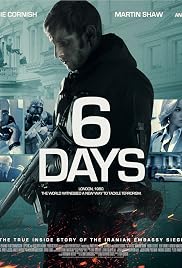
6 Days


This review may contain spoilers!

This is a film that you know isn't half bad to watch, yet somehow you can't help but walk out bored. I would give 6 Days a 6/10.

This film does an amazing job of managing to be quite an informative biopic; you're cast straight back to the event and given historical information that is pretty intriguing to engage with. The film also manages to keep an atmospheric and delicate tension which does wonders for the negotiator/terrorist dynamic. Everything about this film was 'setting the scene' and it was incredible to see the ways in which multiple plots built up to the assault upon the embassy.

Mark Strong, who played Max Vernon, was quite a morally duplicitous figure; the way he manipulated both the terrorists and his own wife by the end of the film really made you question the integrity of this role. Tim Pigott-Smith and Robert Portal, who played William Whitelaw and Colonel Mike Rose respectively, presented a really interesting insight into the political aspect of this terror event; the exceptionally satirical discussion around Margaret Thatcher provided a bit of personality to this film.

However the best performance came from Ben Turner, who played Salim. Turner is placed in the difficult position of being the voice of the terrorists for this film; the way he acts sets the tone for whether the antagonists are quite stereotypical in their portrayal or if they feel like individual characters. There's a real sense of desperation in this performance, he's a wild card teetering on the edge of control. I like how Turner played this character as very conflicted and even confused at times, it was clear his role didn't have complete control of the hostage situation and he didn't know how to handle the severity of this.

This might be a film faithful to what happened but it struggles to create a narrative that makes you care. Throughout the film you are introduced to a wide variety of rigid roles who don' display any qualities which make you like them all that much, you want to find a point of connection with the film but struggle to as an audience member. Beyond this the final moral message of the story is a little vague; it both condemns the actions of law enforcement in this event while celebrating a successful response to a terrorist threat. The tension aspect of the film is great but it makes for one long running aspect of the film, the story runs at quite a monotone pace. The cinematography for the film is quite drab and grey, this certainly isn't much to look at. The way this film is cut speaks of poor editing, it was a chore to sit through the entire feature due to the gradual pace of 6 Days. The score for the film is entirely forgettable, it neither provides anything to the tone nor does it leave an impression upon the viewer.

Jamie Bell and Emun Elliott, who played Rusty Firmin and Roy respectively, are both a pair of adrenaline-filled soldiers overflowing with bravado; this pair are painted to be the protagonists of the film but they aren't very likeable nor easy to connect with. Abbie Cornish, who played Kate Adie, often doesn't feel like she fits very well into the story; Cornish is quite a stiff role and is often presenting a heavy hit of exposition. Aymen Hamdouchi, who played Faisal, does quite the opposite of Turner; Hamdouchi presents a very generic portrayal of Hollywood terrorism. Toby Leach, who played Trevor Lock, sadly falls into the background throughout this film; Leach has a lot of heart and could've been an alright role if he wasn't reduced to a bumbling figure by the film's end.

Sunday, 24 September 2017

Wind River


This review may contain spoilers!

A part of me wonders if the film would be better served without the type of lead it has; yet I cannot deny that this film is one of the best to come out of 2017. I would give Wind River a 9/10.

This film is exciting because it ventures into a setting that many have been too afraid or ashamed to portray: a Native American reservation. Yet Wind River presents a spiritual home that connects with the natural world around it in a way that will blow you away; the harsh landscape challenges the characters and us as an audience. The brutal act of a Native American girl being sexually violated and murdered confronts the viewer with the stark reality that Native American people still aren't receiving justice within their own country, It's a heartbreaking truth told through an empathetic story. The cinematography does such a great job of capturing the open and wild landscape of the Wind River setting, yet it also manages to tighten up on the action when the pace picks up and the fierce side of the characters is revealed. The editing really has a great sequence to it, lingering upon moments where we should reflect but moving at speed when the criminal investigation grows exciting. The score really has this deep connection to the unforgiving natural world that unfolds within Wind River, this is complimented exceptionally well with Native American poetry that speaks to the cultural identity of the film.

Jeremy Renner, who played Cory Lambert, is a great protagonist for this film; Renner brings forth a powerful figure who has a deep understanding of loss and man's relationship with the natural world. Graham Greene, who played Ben, is a role that really has a hard edge to him after years of protecting the Wind River reservation; Greene brings forth a good-natured individual who is as much a part of his community as Renner is. Elizabeth Olsen, who played Jane Banner, is quite a timid role which contrasts greatly with her federal agent title; Olsen does a great job of portraying an inexperienced individual who has to grow up fast to solve her case. Tantoo Cardinal, who played Alice Crowheart, has a really fierce amount of energy which made her scene stand out; Cardinal clearly shows the pain she has already had to endure within her life and the anger she feels at being sent inexperienced Olsen. Eric Lange, who played Dr. Whitehurst, is quite a clinical and honest portrayal of a mortician; Lange really navigates the bureaucratic legalities of the position well. Gil Birmingham, who played Martin, is one of the most emotionally grounded performances of the film; his incredible chemistry with Renner and exquisite portrayal of grief make this a performance worth remembering. Hugh Dillon and James Jordan, who played Curtis and Pete Mickens respectively, make for some incredible antagonists in this film; the deceptive and slimey nature of these roles is brilliantly portrayed by this pair.

However the best performance came from Jon Bernthal, who played Matt. This is a role that is exceptionally charismatic, despite the red herring that he is an antagonist when first we meet him. Bernthal plays this set up quite well, then progresses to bring forth one of the most likeable characters of the film. In a lot of ways Bernthal is an example of an honourable figure in a dishonourable environment and that dynamic is interesting to watch unfold. I was really impressed with Bernthal's ability to play such an infatuated and romantic figure, while also bringing forth an aggressive brawler when the scene requires it.

Wind River feels like a Native American story, or at least a story about injustices done to Native American people, so it feels a bit off-brand that the story is lead by a non-Native American protagonist. It's a story that will completely move you and is quite pointedly one of the best films of the year but you can't help but feel that it's missing the obvious as the plot unfolds.

Julia Jones, who played Wilma, provides a glimpse into the shattered remains of Renner's family life but provides little else to the film; the frosty reception from the ex-wife comes off as a tired trope in this film. Teo Briones, who played Casey, is a nice enough emotional bond for Renner in the first twenty minutes of the film; yet weirdly after this time he seems to stop existing or mattering much as a character. Apesanahkwat, who played Dan Crowheart, gives quite a tired performance that doesn't serve as a great introduction to the Wind River cast; his 'guidance' of Renner feels a little over the top. Tyler Laracca, who played Frank, is quite over the top in his portrayal of grief compared to the rest of the cast; Laracca is one of the more inexperienced performers and it shows in his interactions with other cast members.