Popular Posts
-
This review may contain spoilers! Most of this film feels like a cheesy extended tourist ad for Samoa. I would give Three Wise Cousins ...
-
This review may contain spoilers! Certainly quite a bizarre film, but it's originality and beautiful style sets it apart from many ot...
-
This review may contain spoilers! If you love zombie films then you have to go check this out! I would give Train To Busan a 7/10. This...
-
This review may contain spoilers! While not the greatest war film that I've ever seen, Michael Bay delivers an action packed glimpse ...
-
This review may contain spoilers! This film is probably one of the more thought provoking films Marvel has done and I'd say it certai...
Wednesday, 9 September 2020
Mulan
This review may contain spoilers!
We are now striking up yet another lifeless husk of a Disney live-action adaptation. I would give Mulan a 4/10.
Mulan is a live-action adaptation of the Chinese legend and animated Disney film of the same name. Within this film we follow Mulan as she takes her father's place in the Imperial army and risks her own life to stop Bori Khan and the nomadic tribes from invading the Empire. I felt this film did a good initial job of setting up a really threatening antagonist; when first Khan appears onscreen you get the sense that he is capable of a lot of carnage even with a small number. Seeing a villain who is capable of manipulating those around him to cement his power and then utilise all he wields to decimate the heroic forces is really appealing to watch. I also thought the film did it's best in the second act when it was feeling out the camaraderie in the military camp and Mulan was navigating how she would fit in with her fellow soldiers. There were scenes with good humour and even character exploration that left me genuinely interested. The score for the film is this powerful harmonious blend of the original score from the first film and a powerful ballad that speaks often to the setting and the more mystical nature of this film.
Yoson An, who played Honghui, is a rather aloof yet charismatic role in this film; An is a really likeable friend to the protagonist and is a key bridge to her finding her own way as a warrior. Pei-Pei Cheng, who played the Matchmaker, really strongly embodies the cold discipline of this character; the almost comic displays of brutal rage make this one of the more memorable minor roles in the feature.
However, the best performance came from Jason Scott Lee, who played Bori Khan. This was an antagonist who could back up everything he said or did onscreen for almost all the time we saw him. Lee was this relentless, intimidating force throughout; you believed he was a warlord and he filled a scene the moment he stepped into frame. This character wasn't just all brute power either which I liked, Bori Khan used cunning to trick his foes and allies alike and then used his own cunning to control many powerful assets he had at his disposal. I enjoyed seeing Lee play up the themes of vengeance with this role, his hatred for the Emperor was palpable and it was when he allowed this to guide him that we saw the beginning of Bori Khan's descent into defeat.
This movie never really felt like it was in strong hands while you watched it, wjetjer it was narratively or visually the film had a tendency to trip over itself somewhat. This movie paints Mulan as a young woman capable of greatness due to a magic spiritual ability called 'chi', which is a problem for a number of reasons. Firstly Chi is represented as an ability that enhances fighting, allows opponents to move or or fight in ways they couldn't otherwise, use telekinesis and there was one antagonist who used the power to become a flock of birds. Chi was this plot device that allowed the characters to do whatever they wanted or needed to advance the plot, it became a serious crutch for the film. It also de-legitimised Mulan's story, she rises above prejudice because of her own bravery and merits in past stories we've been told. This film paints Mulan as some all-powerful chosen one, who gets to unlock the magical power of Chi once she reveals herself to be a woman to the army she served. The narrative doesn't really paint Mulan as someone who has emerged this powerful and capable warrior in spite of the prejudices against her, rather the film gave her powers and turned her into a magical martial artist with a half-baked female empowerment plot that is never really explored.The film constantly rings hollow and underutilises some key plot elements while extensively over-utilising others. For example, the constant display of the phoenix to represent Mulan's connection to family and sincerity to herself is shoved into scenes rather than functioning as an active element of the film. The film itself only ever looks good when the location looks good, often a scene feels set up and that often makes you feel like you're watching events that have been filmed on a small set pretending to be bigger than it is. The special effects throughout look terrible, with some of the CGI creatures such as the bird or phoenix looking distinctly out of place.
Yifei Liu, who played Mulan, moves through this film doing what a scene requires but never really crafting a character you connect with or care for; Liu's Mulan works to what individual scenes require of her and I struggled to see this role go through any sort of arc that felt personal. Donnie Yen, who played Commander Tung, is wasted in this stoic military leader role; not only is this a role drained of emotion but it felt like a cheap casting to just see Yen do some of his signature stunt work in a smattering of scenes. Li Gong, who played Xianniang, is a relatively new antagonist who function as a poor mirror to a poor protagonist; Gong hurtles from overly sinister to morally conflicted and it becomes hard to believe she fully follows the direction of her character's motivation. Jet Li, who played the Emperor, doesn't display much in the realm of emotional range or character portrayal; Li holds firmly onto stoic delivery and doesn't let go of that guiding principle the entire film. Tzi Ma, who played Zhou, is so much angrier and more reactionary than what you'd expect for a father figure whom the protagonist cares for so deeply; Ma doesn't really seem to know how to play to the father role he's been given and this doesn't make for a very fulfilling relationship played out onscreen. Rosalind Chao and Xana Tang, who played Li and Xiu respectively, are more background figures than Mulan's family at times; Chao is often denied opportunity in favour of Ma, while Tang's sisterly portrayal never has much depth to it beyond a shared family joke. Jun Yu, Chen Tang, Doua Moua and Jimmy Wong, who played Cricket, Yao, Po and Ling respectively, are a signature group seemingly added for comedy and as points of connection for the protagonist during the second act; yet as a group these roles don't live up to the task and it's pretty easy to forget they're even there at all.
Monday, 7 September 2020
The New Mutants
This review may contain spoilers!
I never thought that I would be so emotionally invested in the last Fox produced X-Men film, but here we are. I would give The New Mutants a 7.5/10.
The New Mutants follows a young group of mutants who have manifested dangerous abilities and are kept within a dark holding facility in an effort to teach them to control their powers. However, not everything is as it seems at the facility and the nightmares of the young mutants begin to come to life.While watching this movie it didn't take long before I realised something; this might not be the best X-Men universe film but it is the most X-men film we've probably ever had. Let me unpack that a bit. The X-Men have always dealt with significant issues around equality and civil rights, often through the filter of a big superhero battle or threat. This film presents us with a facility that isolates and attempts to correct young people because they are mutants, because they are different from others. The main protagonist of the feature is a Native American girl who is the sole survivor of an attack upon her reservation and is now suffering through that loss while trying to navigate a very hostile new environment. This film takes it's time to get going in the first act but once we get to see the leading characters interact with one another and form bonds then you really begin making a connection with that which you're watching. One of the biggest examples of this I thought was the relationship that developed between Dani and Rahne, these were two very vulnerable characters who worked together to rescue one another from the prison that had been trapped in. I also felt that the horror elements of the film served the narrative strongly, crafting a way for us to understand the characters more while also presenting really bone-chilling adversaries for our heroes. The cinematography for the film is consistently nice to watch, keeping a really intimate dynamic between the numerous leads and making expansive use of the original set pieces. The special effects for the film almost always look great, the design for Magik, Lockheed and the Demon Bear being some of the creations worthy of note.
Charlie Heaton, who played Sam Guthrie, is wracked with guilt over the origins of his power when we are first introduced to him; Heaton balances a character who is fiercely loyal to his friends while devastated by his harrowing past. Blu Hunt, who played Danielle Moonstar, holds strong in the difficult position of lead protagonist; Hunt's journey from the hurt of being a sole survivor role to discovering love and a family in her new friends is such a great character arc to watch. Henry Zaga, who played Roberto da Costa, is immensely charismatic from the moment his role appear onscreen; I like the tough facade he displays in front of the group initially and how quickly that crumbles by film's end.
However, the best performance came from Maisie Williams, who played Rahne Sinclair. I loved Williams as Arya Stark but really this might be my favourite role of hers that I've watched so far. She has a very guarded approach when first introduced, the hard aspects of her past leave her reluctant to move forward. Yet in spite of this she is driven forward by a desire to escape, she wants to be in control of her power so that she can move on and live normally again. From the moment they first share a long scene together I was blown away by the chemistry between Williams and Hunt, they have this shy yet trusting friendship that evolves into this really lovely dependable onscreen romance. Superhero film romances are often notoriously bad but this was one of the strong aspects of the feature without a doubt, just watch the scene where Williams' character gets embarrassed about her wolf ears in front of Hunt and you tell me that isn't amazing. Williams crafts a role who grows stronger after facing her fears and by finding someone to fight for in the facility, she becomes the hero who will stop at nothing to save those she cares for. This was a knockout role and one of my favourite new superhero performances.
The New Mutants was a surprisingly good hit for me but it was also supposed to release a couple of years ago and it shows. The film never really went through the full production process it was intended to and the narrative does possess some very disjointed moments to watch. This manifests with sudden scenes in which characters get very friendly with one another very quick or the nightmare component of the film escalates dramatically. These are fine thing that with a little tuning could've run much smoother. The first act of the film isn't a great starting point; the arrival into the facility is a long drawn out introduction process that lays out the setting, characters and key plot elements in several long exposition heavy scenes. The ultimate result is a rather slow beginning that takes its time to pick up the pace. The film also has no significant plot twists in store for the audience, the source of the nightmare creations is abundantly obvious from as early as the first ten minutes and the threat of the facility they are all housed in is a bit of a given. The final fight of the film is a bit anti-climatic in the sense we don't get much of a powers display and the idea of kindness to yourself defeating the big bad is a bit of a tough sell. There are several effects or editing moments in which some of the background drama has clearly created a rushed if not entirely polished visual product. The score for the film flaunts some very eerie tracks but there's nothing here that you'll really remember or that will have you on the edge of your seat come the end of the film.
Anya Taylor-Joy, who played Illyana Rasputin, was caught with the wild card role that was just too twisted and zany to ever really flesh a likeable character out of; Taylor-Joy's character was the 'bully' character who was tough to like and her certain about change wasn't very convincing. Alice Braga, who played Dr. Reyes, was a very toneless role who was pretty easy to predict as the feature antagonist; Braga just played the scientist component of this character as drily as possible which sadly lead to a pretty forgettable role.
Wednesday, 2 September 2020
Bill And Ted Face The Music
This review may contain spoilers!
This is far more Bogus Journey than Excellent Adventure, a major bummer. I would give Bill And Ted Face The Music a 1.5/10.
Bill and Ted Face The Music sees our heroes continue in their efforts to create the song that will save all reality and unite humanity. However, when faced with an impending doomsday deadline the duo head into the future to steal the song from their future selves while their daughters travel to the past to assemble a most bodacious band. This film really succeeds comedically in a few scenes where it isn't trying to be funny; like in the original movies the nature of the scenes are absurd so comedy and hilarity ensue. It's moments like these which gave me a point of connection to the original films and also managed to leave me feeling entertained.
Keanu Reeves and Alex Winter, who played Ted and Bill respectively, still fall into these roles as if it were yesterday; the aloof delivery and unbelievable onscreen chemistry is as fresh as it was in the first Bill and Ted. William Sadler, who played Death, was one of the best performances in Bogus Journey and still such a pleasure to watch; I loved seeing Sadler go full rock star diva in the wake of his role exiting the Wyld Stallions between films. Hal Landon Jr., who played Chief Logan, has always been so consistently great as the stoic father figure to Reeves' Ted; I really enjoyed watching Landon Jr. continue to tirade and attempt to guide the two protagonists. Jillian Bell, who played Dr. Taylor Wood, was only a minor role in this film but such a great performance all the same; Bell did a very good job of reacting in quite a grounded way to a very absurd set of scenes which only really heightened the humour of the moments.
However, the best performance came from Samara Weaving and Brigette Lundy Paine, who played Thea and Billie respectively. I really enjoyed seeing a new younger pair take a swing at all the familiar movements and expressions we normally get from Winter and Reeves. It just felt like these leading performers had more energy and enthusiasm for their scenes, which meant any time they were onscreen you felt the thrill of the adventure component of the story again. Weaving and Lundy-Paine bounce off one another effortlessly, they felt like best friends and shared a dynamic that outshined any other in the film. This was a stand out duo performance that really brought a bit of charm to this Bill and Ted movie. If there ever had to be another Bill and Ted, then it's Weaving and Lundy-Paine I'd like to see.
This film suffers majorly due to such a glaringly bad plot. The original films don't have stunning stories either, but the reason that works is because they know and under stand that. This film on the other hand tries to take itself a little too seriously for what has always been an absurd comedy series. The film starts with us discovering that Bill and Ted no longer are just responsible for uniting the human race but from preventing the end of all reality. The film really pushes this idea that it's 'bigger' and more 'significant than any other adventure our heroes have been on before. From there you watch Bill and Ted squabble through the complicated dynamics of being failed middle-aged adults, go through marriage counselling and worry about being a washed up band. The tone gets a lot more hum-drum, though the leads are still their goofy selves they've lost a lot of what made them so positive to watch. Even the adventure into the past to collect historical figures that the daughters go on isn't particularly well executed; there's a lot of justification and work into acquiring each character which takes a lot of fun out of that particular storyline. You can only watch so many scenes of Bill and Ted arguing with future versions of themselves, listen to poorly delivered scientific theories from Kid Cudi or hear a self-aware annoying robot tag along so many times before you have to admit that sometimes a nostalgic cult hit doesn't really need a sequel. The cinematography for the film doesn't look very well mapped out and there's not a lot in terms of style to the film. The special effects look like they tried which makes their failure so much worse, the charm of the old films was they knew that their special effects were bad but this movie refuses to play to that. The score for the film is very piecemeal and thrown together, while the soundtrack is pretty dull for a film that so heavily centres upon music.
Kristen Schaal, who played Kelly, is wasted as this film's go to for all things exposition and explanation; Schaal is a comedy powerhouse and it's a struggle to see her have to deliver a lot of very bland lines in all of her scenes. Anthony Carrigan, who played Dennis Caleb McCoy, had to be the worst role of the feature; this character was a throwaway goon up until the feature made him an annoying minor role with way more screen time and dialogue than he deserved. Erinn Hayes and Jayma Mays, who played Elizabeth and Joanna respectively, just did not function at all as the wives of the two main protagonists; a significant aspect of the story was around the marriages of these characters but you never saw any sort of connection or romance between them at all. Beck Bennett, who played Deacon, was completely shunted to the background as Reeves' brother; Bennett just never connects with any of the cast members he's supposed to be family with which really makes him a small blip in the film. Kid Cudi, who played himself, isn't fooling anyone as this hyperaware abundantly scientific version of himself; the spam of jargon that Cudi expels sounds learnt but with no real knowledge of what he's actually saying. Holland Taylor, who played The Great Leader, is quite a generic stoic leader from the future; her stern commitment to the end goal and little in terms of an emotional performance makes the future one of the least exciting settings in this film. DazMann Still, Jeremiah Craft, Sharon Gee, Patty Anne Miller and Daniel Dorr, who played Jimi Hendrix, Louis Armstrong, Ling Lun, Grom and Mozart respectively, are almost worst historical figures in this film because they have to appear more convincing than historical cast members in previous films; Still and Craft in particular get the most screen time and as a result feel the most like they're just pushing pale imitations of their roles.
Sunday, 23 August 2020
Tenet
This review may contain spoilers!
This has taken the spot of my least favourite Christopher Nolan film for sure. I would give Tenet a 6/10.
Tenet is a sci-fi thriller that follows the exploits of the 'Protagonist' and the shadow organisation that recruits him as they attempt to stop a future World War before it transpires. This is a feature that has quite a few facets to it and the ones that work well are far more remarkable than the ones that don't. Specifically this film has a strong emphasis on being an espionage-type thriller which really brings a fine level of intrigue to the piece. The cloak and daggers game of trust and betrayal between the Protagonist and the film's antagonist, Andrei Sator, is quite gripping to watch. The Protagonist plays a game of infiltration and is equally capable at talking or punching his way out of a crisis. Yet the conflict is heightened by an antagonist who seems to have a more calculating intellect and makes use of his vast pools of resources to keep his edge for almost the entire narrative. Deeper than this main running espionage story is a more personal conflict between Andrei and his wife, Kat. This was a really gripping personal drama in which Kat has become trapped in her own life, blackmail and threats have tied her forever to her husband and the film does a great job of exploring their entwined struggle and her efforts to escape. The cinematography for this feature is the incredibly polished high-grade style we've come to expect from a Nolan feature; this movie feels sharp and the camerawork flaunts the expensive sets and set-up that go into crafting a blockbuster of this scale. The score for the film is very gripping and terribly foreboding; the intense atmosphere set by the music is guaranteed to have you on the edge of your seat in a few key scenes.
Kenneth Branagh, who played Andrei Sator, provies once again why he's one of the best performer out there as the antagonist for this feature; Branagh's extreme burst of passionate rage coupled with the devilish cunning he brings are absolutely terrifying to watch. Michael Caine, who played Michael Crosby, is a firm staple of Nolan's filmography for a very good reason, Caine is very effective as the smug, yet proficient upper class businessman. Martin Donovan, who played Victor, is one of the few performers who actually handles exposition really well; Donovan has this delivery that leaves you with a sense of foreboding of what's to come.
However, the best performance came from Elizabeth Debicki, who played Kat. This role was so completely engaging to me because in a film with time anomalies and guns that catch bullets we had an incredible female protagonist fighting to escape the trap her life had become. Debicki is all class from the moment she arrives on-screen, she has this easy sophistication about her that makes you see her as being comfortable within her life of luxury. Yet as we come to see her more within the film you see the terror she lives with, her fear and intense reactions to Branagh are absolutely staggering. All throughout the feature you watch this woman rebuild herself, from being terrified of her husband to becoming the retribution against him. Debicki probably has the most satisfying and fulfilling character arc to come from Tenet and while I didn't know it at the time, she was why I paid the price of admission.
Christopher Nolan is an incredibly intelligent man with the capacity for killer screen writing, but even a great writer/director slips. Earlier I mentioned the many facets of Tenet and this was a pretty important statement, Tenet is a very busy beast of a feature with a number of plots relying upon one another to make the whole. Unfortunately, the selling point for the film, the sci-fi time element, is one of the film's worst aspects. The writing for the various time theories feels like it was written by someone with a very surface-level understanding of the core concept applying said theories to a narrative that doesn't really bring out their strengths. The movie backtracks and contradicts itself constantly in order to set-up a plot twist or introduce a new time theory to discuss. When we started talking about the Grandfather Paradox or the Protagonist survives a car explosion because he's 'inverted' you have to start wondering if Nolan knows what he's talking about. The film pushes the obvious time travel plot twists of future selves interacting with past selves or current selves going off to die because it was foreshadowed earlier in the film. This is a movie that constantly tries to pass itself off as rather clever while unashamedly utilising all the worst qualities of a time travel blockbuster film. The dialogue for the movie is also remarkably poor, with empty philosophical statements, long drawn out exposition and hastily delivered quips that seem very out of place. The special effects style for the film is also pretty terrible, the way inversion is presented is by no means appealing to the eye and might be the worst looking effects work I've seen in such a high calibre film.
Robert Pattinson, who played Neil, just kind of inexplicably shows up near the end of Act One and proceeds to stage whisper every single line he has in the film; Pattinson doesn't really push a lot of emotion or effort into his character which makes him rather dull to watch. John David Washington, who played the Protagonist, starts off the film with a good footing but grows steadily monotonous as the film goes along; Washington has little to no range opting to coolly throw out a one-liner or uncertainly ask questions as opposed to feeling like anything resembling a character. Aaron Taylor-Johnson, who played Ives, enters the film out of nowhere spouting some of the most nonsensical dialogue thus far; Taylor-Johnson's tough military persona just feels generic and shunts him right into the background. Clemence Poesy, who played Laura, seems completely drained of energy; Poesy has some of the most important exposition to deliver but she feels tired and deflated to listen to. Himesh Patel, who played Mahir, comes across as more of a comedic role which really clashes with the overall tone the film is going for; Patel is like a piece that just does not fit in the big action sequences. Dimple Kapadia, who played Priya, does not have very clear line delivery and really suffers as the one who seems to be the most clued into what is going on; her cryptic yet wise delivery feels pretty played out and she is consistently in some of the most boring scenes in the film.
Thursday, 20 August 2020
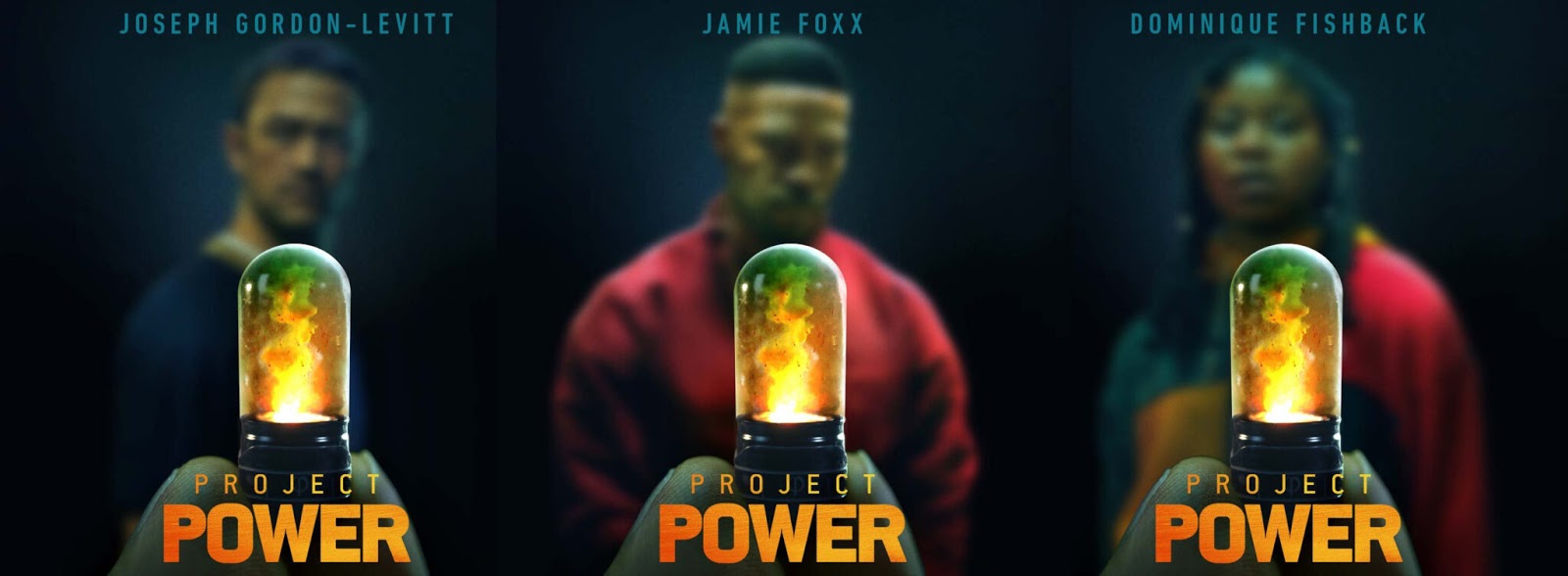
Project Power
This review may contain spoilers!
Sometimes you get a sharp reminder that 'original streaming service film' can mean the same thing as what we used to call a 'direct to DVD/Blu-ray film'. I would give Project Power a 2.5/10.
Project Power takes us to a world in which people can take a drug to get a random superpower for five minutes. This drug is flooding the streets of New Orleans like wildfire and ties together our three protagonists, a pill-popping cop, an underage dealer and a drifter searching for his daughter. The first act of Project Power is where the strength of it lies; the introductions to a superhero world that is a little different and promises a blend of gangster-crime feature. We get to see how a superhuman drug works on the streets, how street culture reacts to it and how the police/crime element shifts sharply to such a violent new chemical at play.
The best performance came from Joseph Gordon-Levitt, who played Frank. I liked this character because he had some degrees of complexity to him that I thought were quite well explored. Gordon-Levitt presents a charismatic police officer who tends to operate in a very morally grey way, taking the same Power drug the criminals he's pursuing are. I liked watching the lengths this character would go to do what's right for the people of New Orleans, he gives all characters he encounters an equally fair measure and stands as one of the more noble figures in the feature. I also enjoyed seeing how Gordon-Levitt played to his character relying on the drug to protect and serve, his need for Power in order to combat Power is one of the more compelling conflicts in the film.
Project Power rushes before it even finishes laying down the groundwork, we barely establish the Power drug scene before we're catapulted into the main protagonist's story. The main character for this film is an underage drug dealer who pushes the Power product, chiefly selling to protagonist cop: Frank. This main character, Robin, is a really loose binding thread between all the storylines and characters in the feature but it's often hard to understand what purpose she serves. Her whole role is warped between being a hardass drug dealer, a genuine good human being, a wannabe rapper and a downright nervous individual. She seems to be torn between what the film needs her to be and what the creators of the film want her to represent and they never find a nice point in which these things meld together. Likewise the introduction of Art/The Major is very frustrating. He enters the film in true action movie fashion, all stunts and little dialogue. It takes a very long time for us to have any idea of Art's purpose in the film or what even motivates him as a character, but by delaying this information the feature feels more and more like a hollow action piece. Once we get the big reveal that the Power drug is a government experiment being used on the New Orleans populace and that Art's daughter is one of the sources of the drug then the film really takes a convoluted turn for the worst. The film becomes more and more about poorly constructed action scenes being slogged through in order to save the kid and tear down this really vague government threat. The cinematography for the film felt like someone trying their best to make a cool looking film without any idea how to keep to a consistent style, it was like watching a music video in which there's a lot of showy visuals but the style isn't very complex. The visual effects for the film were horrendous with some of the worst CGI I've had to struggle through in a while, the film spends a lot of the time cutting away or using camerawork to hide visual effects shots. The score for the film was pretty tame and never amped up the action, the soundtrack also had quite a toned down style and boasted some pretty unappealing hip-hop.
Jamie Foxx, who played Art, is a surprisingly bland protagonist for this film; Foxx is so obsessed with playing to this monotonous, yet cool tone that you don't really feel like his role has any emotional range. Dominique Fishback, who played Robin, was a character I really struggled to see the point of; Fishback's intermittent rapping felt like a really forced aspect of the story that never added anything to the plot or her character. Rodrigo Santoro, who played Biggie, really oversold his role as the supplier of drug product; the way he is constantly selling or grandstanding feels melodramatic to the extreme. Courtney B. Vance, who played Captain Craine, looks bored to be in this feature; he lacks subtlety and the big reveal around his role's true intentions comes as no surprise. Amy Landecker, who played Gardner, was the worst of the antagonists we had thrown our way; Landecker is poised as the big final villain but she comes across as stoic and emotionless which undercuts the significance of her role. Machine Gun Kelly, who played Newt, has been diminished in the types of roles he plays for a while now; this role is one of the blink and you'll miss it special effects characters that appears in quite a forgettable scene. Kyanna Simone Simpson, who played Tracy, really plays to the stereotype of captive daughter; a lot of grateful tears at getting 'rescued' but no real connection between her or Foxx to sell it. Rose Bianco, who played Matriarch, seemed a little overwhelmed with the scenes in which she portrayed a buyer for the Power drug; Bianco almost seemed to shrink away from the tough role she had to portray.
Wednesday, 12 August 2020
This Town
This review may contain spoilers!
This Town is by far one of my favourite comedies of 2020, and more importantly, one of the best New Zealand films I've seen in a while. I would give This Town a 7.5/10.
This Town follows Sean, a young rural New Zealander who is the last surviving member of his family and the former prime suspect in their murder case. As an innocent man with accusations of murder haunting his life Sean wants little more than to find love and carry on with his life; and while there is hope he might just wind up happy, former police offer Pam is relentlessly trying to prove his guilt. This is a mockumentary that achieves something I haven't seen from the medium in a couple of years, we get a fresh comedic spin on the genre and a gripping narrative that has heart to spare. What I love so much about this film is that there's something in it that every New Zealander is going to see and recognise; you might not live exactly the same but the mannerisms and cultural norms that are parodied are spot on. This film really has some diversity in its comedic storytelling too; you'll have one scene with a very stoic cop and then jump to our charismatic if not somewhat awkward protagonists and then across to these vain, gossiping editors from a That's Life-esque magazine. Any time you think This Town might be getting laboured and have to drop the ball on its sense of humour it takes a moment to find a new angle so that you never get bored of just how funny this film really is. I also thought This Town navigated the complexities of an accused murderer living within a community really well; there are of course similarities to the infamous David Bain case but the feature makes marked strides to isolate its own take. The exploration of how guilt is perceived and judged even after a trial gets very honest within some scenes, making Sean as much a victim of mob mentality as he is still a suspicious character for the audience. The ingenuity of the narrative is making you as invested in Sean and Casey's Storyline as you are in Pam's, in fact a lot of the film makes you consider Pam's perspective and leaves you puzzling if Sean really is as charismatic as he seems. The film is a really satisfying journey of realised potential, it's hilarious and holds your attention consistently. The cinematography feels really stylised towards the mockumentary genre, but it also manages to capitalise on some very comedic props and the exquisite backdrop of Kiwi scenery. The soundtrack for the feature is beautiful, containing tracks that enhance the comedy of some scenes and the romantic nature of the protagonists' story in others.
David White, who played Sean, makes for such a great focal point as the films protagonist; White is comfortable with setting the awkward comedic style and generates a charismatic lead throughout. Alice May Connolly, who played Casey, has a bunch of chemistry with White and develops an on-screen romance that feels genuine to watch; I like the amount of heart and optimism that comes from this role. Rima Te Wiata, who played Janice, is hilarious as the shallow smalltown reporter looking to make her bestseller mark; the ability Te Wiata has of taking the spotlight effortlessly and with a little bit of deliberate force makes the character all the better to watch. Byron Coll, who played Tony, is one of the characters who is almost consistently stealing the show; the way Coll lifts up Malcolm's character consistently or is confessing how much he toes the line in his police duties makes this role a delight. Peter Hambleton, who played George, grounds the film as a weary husband to Malcolm's obsessive role; watching Hambleton delicately and insistently navigate scenes in which he explores how the case has impacted their relationship is brilliant. Jeremy Randerson and Gabe McDonnell, who played the Magazine Editors for Women R Us, are one of my favourite comedic duos in the feature; this pair manages to inhabit the shallow, vicious and ironic nature of the gossip rag world.
However, the best performance came from Robyn Malcolm, who played Pam. I really liked how seriously stoic and fixed on her target this former cop turned private investigator/adventure park owner was. Malcolm really found her way into this stubborn mindset of doggedly pursuing a goal and letting that invade every character moment she had. There are several scenes in which Pam is in a situation not necessarily suited to her straight-edged demeanour but it is this point of difference that enhances her comedic value. I also think Malcolm's skill as a performer lifts the dramatic narrative too; you see this when she emotionally re-enacts the crime within the former crime scene, providing commentary and reactions as she goes. This is a role that inspires some of the best humour in the film but also marks this feature as a step above any other comedy you're going to see this year.
This film really takes it's time feeling out how it presents comedy at first, tending to linger on long pauses for the sake of ensuring the audience absorbs the joke and enhancing the awkward tone. However, there are a number of times when the film doesn't always manage this timing well and it can result in scenes that drag on and in some instances, you lose the power of a punchline. The editing follows this on-again, off-again presentation; sometimes hitting a perfect flow and other times not really knowing when to make a cut. I also thought The Town lost itself in its dramatic narrative at one given point, trying to present conflict within the film with a pregnancy scare. While it handled themes of abortion appropriately, I really felt the film muddied its two main characters with a storyline that felt more soap opera than clever storytelling.
Aaron Cortesi and Loren Taylor, who played Alex and Jules respectively, are the de facto 'friend' characters to the protagonist but he relationship isn't very well explored most of the time; Cortesi and White don't do anything to make their interactions unique or exciting while Taylor's role never gets the opportunity to be explored in great detail. Amelia Reid, who played Amanda, really struggles to play a character with any trace of subtlety; Reid's scene was led entirely by Malcolm and she (Reid) clearly struggled to keep up. Jack Sergent, who played Harold, really didn't do much to hide the fact he was the films ultimate antagonist; Sergent played a toneless, flat character that held little energy around Malcolm and Hambleton's performances. Catherine Wilkin and Peter McCauley, who played Grandma Ruth and Grandpa Robert respectively, tended to stray towards the generic when it came to the estranged elderly relatives; Wilkin in particular, had a scene that just felt very stilted in which she reunited with her on-screen grandson (White).
Monday, 3 August 2020
Unhinged
This review may contain spoilers!
Not even Russell Crowe can carry this bland, generic thriller across the finish line. I would give Unhinged a 3/10.
Unhinged follows Rachel, a young mother who is trying to hold together a stressful life when a confrontation with a psychotic individual at an intersection turns her into a target for his twisted revenge. While I do not think the film did a good job of it I have to commend its attempt to run a narrative around the increased stress and anger people face or internalise in their day to day lives and how this is released into the world, there was a real push here to make something grounded in a setting that is familiar. This film really exemplified itself with how it presented violence, the degrees of carnage the main antagonist causes with a couple of cars and household objects is pretty terrifying. Violence is sudden in this film and almost unavoidable, the nature of how inescapable the killer's particular brand of destruction is makes those high stakes scenes so worth watching.
The best performance came from Russell Crowe, who played the Man. I know, insightful character name. Getting past the lack of identity to enhance the paper-thin theme of the plot; Crowe's performance is one of the genuine saving graces of the film. When this role is idle he seems haunted by his own mind, his pain and experiences have really hollowed him out and left this vindictive creature in his place. There are multiple moments throughout the feature in which the Man comes across as very charismatic, offering a moment of connection or blending in with the local patronage of a diner. But the strength in Crowe's performance is how he either steadily descends into the violent persona we are commonly confronted with or he will swiftly switch to this, which really ramps up tension in a scene. This isn't going to be one of the most well-remembered thriller antagonists but Crowe gives more to this film than it really deserves.
This movie never really promises much to begin with, the film premise is quite simply 'what happens if road rage bred a psychopathic killer?' I think that alone already sets up a pretty simplistic thriller but when the feature starts trying to be smarter than it is by incorporating some kind of commentary about the state of society and the boiling mental and emotional pot we're all living in. There is this long montage showing road rage clips to the backdrop of radio/TV presenters talking about the big commute and mental health right at the beginning of the film. It's a sequence that has a really obvious message behind it but it hasn't really done any work to construct a very convincing theme. The film then proceeds to bore us with the most strained attempt I've seen to create realistic and grounded characters who struggle with divorce or have kids that play Fortnite. The film is so insistent that this takes place in 'the real world' that the situation already begins to feel a little stilted long before the Man and Rachel interact. Once the antagonist does enter the scene however, we descend pretty quickly into stereotypical territory. Long drawn out moments of suspense and paranoia, a climbing kill count, the antagonist is near unbeatable and they both shout the same threats and pleas we've heard in every other thriller before. The film fizzles out by taking our vehicle-heavy story off the road and into a simple house confrontation that never manages to achieve a satisfying finale to the journey we go through. The cinematography for this film shows everything to an annoying degree; we get shots of every little detail or exchange within a scene to an annoying extent. This is a film in which you can only make the same shots of your characters driving or clog a scene with a setting from twelve different angles so much. The film doesn't feel polished or edited enough, there needed to be more work done to craft a stylised end product. The score for the feature in non-existent, opting instead for a dull, warbling drone that feels more repetitive than ominous.
Jimmi Simpson, who played Andy, is a bit of a strange appearance in this film; Simpson is caught in such an unassuming background role that I was confused with why he'd even bothered with the part. Caren Pistorius, who played Rachel, really puts her all into this film but it isn't enough to escape such a poor script; Pistorius pushes out generic line after generic line and never finds away to make her protagonist unique or interesting. Gabriel Bateman, who played Kyle, plays his role quite timidly and as such becomes a bit of a wallflower in his scenes; Bateman and Pistorius aren't especially convincing as mother and son which is another big fail for the feature. Austin P. McKenzie, who played Fred, seems so entirely disconnected from the rest of the cast I had trouble reconciling him as a family member relation to Pistorius and Batmena's roles; in any teen-thriller McKenzie would have been the comedic stoner role who probably died first.
Subscribe to:
Posts (Atom)